
In June 1889, Vincent van Gogh wrote a letter to his brother Theo describing the view from his room at the Saint-Paul-de-Mausole asylum. He called the night “more alive with colour than the day.” That letter, and the painting he was simultaneously producing, tell us something extraordinary about the relationship between mental anguish and artistic revelation.
Van Gogh had voluntarily committed himself to the asylum following the infamous incident in Arles — a crisis that resulted in the self-mutilation of his left ear. His mental state was fragile, his days governed by the institution’s rhythms. But mornings, when he was allowed into the garden, and evenings, when the window offered its gifts of light, were his own.
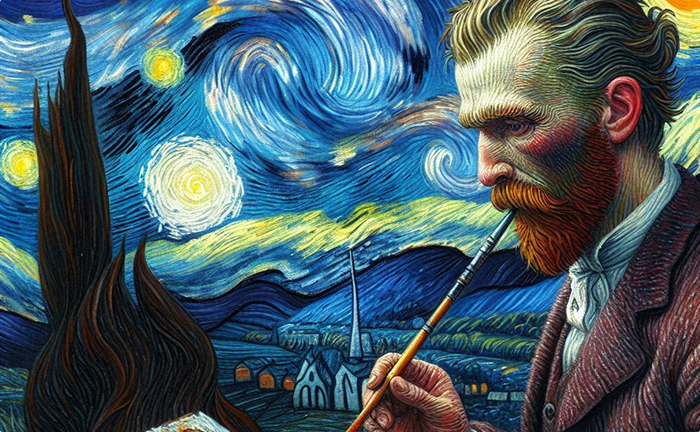
What strikes any viewer immediately upon seeing Starry Night is its refusal of stillness. The sky is not painted — it is churned. The cypress tree at the lower left behaves like a black flame, reaching upward with an almost desperate energy. The hills undulate. The stars are halos, not points. The moon carves its crescent into the surrounding atmosphere like a wound of light.
Art historians have long debated whether the painting depicts a real sky or an imagined one. Studies have confirmed that Van Gogh’s orientation and the approximate date of June 1889 match several astronomical features visible from Saint-Rémy — including Venus, which appears as the large bright body to the right of the central swirl. But the cypress, which does not stand in line with his window’s actual view, was inserted deliberately.
The village in the lower-right is almost universally recognised as a northern European settlement — not Provençal. Some scholars identify the church steeple as distinctly Dutch, invoking Van Gogh’s homeland. This village is, in a sense, a dream of home — composed, peaceful, sleeping — in contrast to the cosmic violence above it.
The cypress holds particular symbolic weight in Mediterranean culture: it is the tree of mourning, planted in cemeteries, pointing toward heaven. In painting it dark and flame-like between earth and sky, Van Gogh may have been positioning himself between the living and the dead — between this convulsive life and whatever lay beyond it.
Starry Night is often cited as a Post-Impressionist masterwork, and it is — but that label risks flattening what makes it extraordinary. Where the Impressionists sought to capture the sensation of light as it registered on the human eye, Van Gogh was after something more subjective: the sensation of reality as it registered on a trembling, over-sensitised nervous system.
The short, agitated brushstrokes that define his mature style are not a technique in the decorative sense. They are a form of notation — of a mind that could not look at a wheat field or a night sky without feeling it physically, without the boundary between perception and emotion dissolving entirely.
Starry Night did not become famous in Van Gogh’s lifetime. He sold almost nothing. The painting was unknown to the general public for decades after his death in 1890. Today it hangs in the Museum of Modern Art in New York, where it receives more visitors than almost any other work on earth — proof, if any were needed, that the most personal art is often the most universal.
One beautifully written art story, every week. Join 40,000+ readers.